
· Nora Whitfield
Best no-pull dog harness: how to judge one
We sell a harness, so start with that: this is not an impartial roundup and we are not going to dress it up as one. What follows are the criteria, the reasoning behind each, and where the harness we sell meets them and where it does not.
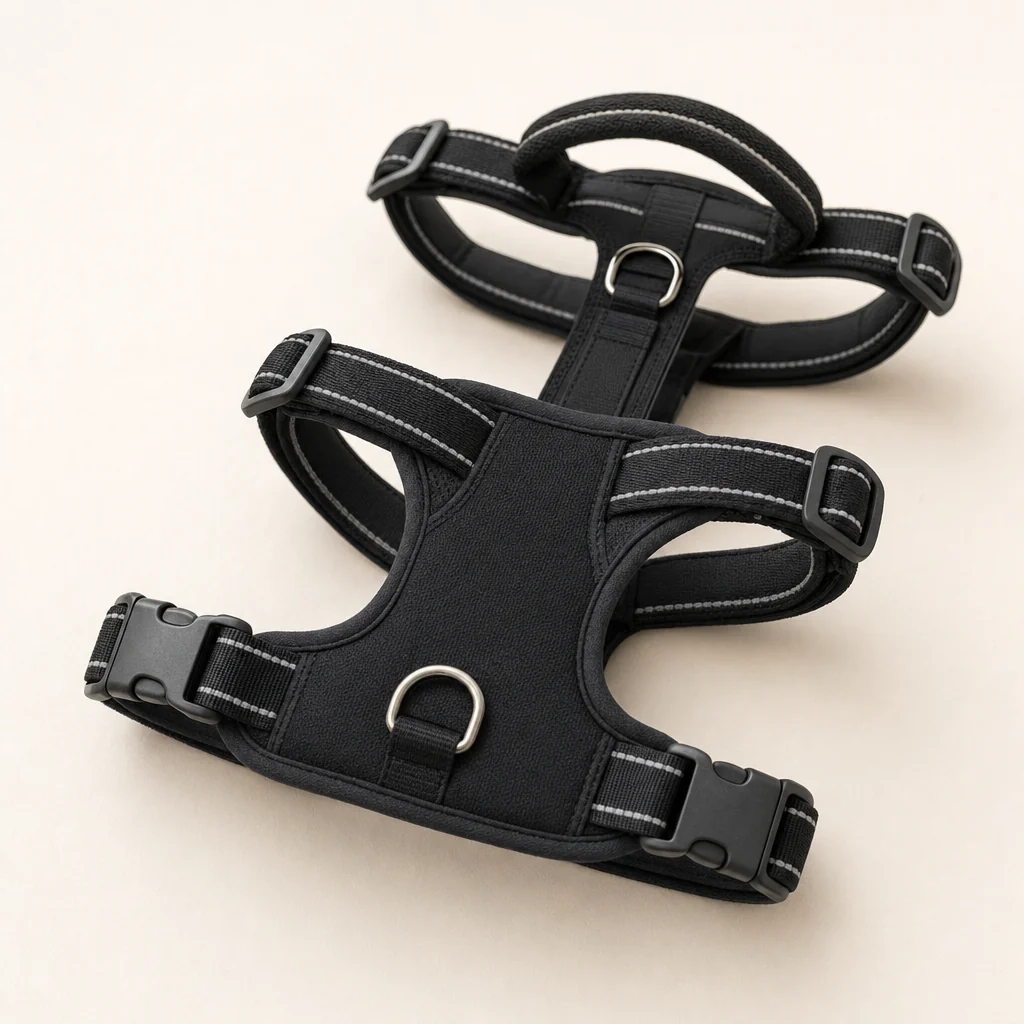
Criterion 1: is there a ring on the chest?
This is not one factor among several. It is the factor. A harness without a chest attachment is not a no-pull harness whatever the packaging says.
16.87 N vs 6.97 N — peak leash tension on a back-attachment harness versus a plain collar, across 52 dogs; time spent pulling roughly doubled (p = 0.031). (Shih et al., Frontiers in Veterinary Science 8:735680, 2021)
A back-only harness was measured producing more than double the peak leash tension of a plain collar across 52 dogs. If the product you are looking at has a single ring between the shoulder blades, that is the configuration you would be buying.
No significant difference — in pulling between a front-clip harness and a metal prong collar across 23 dogs; both beat a martingale collar at p = 0.001. (Johnson & Wynne, PeerJ 12:e18131, 2024)
A front-connection harness, by contrast, cut pulling significantly against a martingale and matched a metal prong collar. Check the photographs before anything else: if you cannot see a ring on the chest panel, move on.
Criterion 2: four adjustment points, not two
Two straps at the neck and two at the girth. The reason is specific rather than a spec-sheet flourish: without neck adjustment you cannot lower the chest panel, and a panel that rides up onto the throat produces every classic front-clip complaint — the leash catching the front legs, the harness choking, the dog backing out.
A harness that adjusts only at the girth will fit the ribcage of almost any dog and correctly position the chest panel on almost none.
Criterion 3: does the chart match your dog?
The best harness in the category is the wrong one if it does not fit. Measure the chest girth behind the front legs before you shortlist anything, and treat the weight column as a sanity check — two 20 kg dogs can be entirely different shapes. Method in how to measure a dog for a harness.
Buyer reports — we cross-checked our own harness's chart against every review naming a size and a real measurement. Two buyers fitted 35 kg Labradors into a size L that the chart caps at 30 kg, both with adjustment left over; a 38 kg dog found XL loose. The chart runs generous, so between sizes, take the smaller. (verified buyer reviews, read September 2026)
Do this check on whatever you are considering. It takes ten minutes of reading reviews and it is the single highest-value thing you can do before buying.
Criterion 4: what does it not claim?
A useful filter, and an unusual one. Look for what a listing is careful about.
Harnesses in this category are routinely advertised with a specific pulling-reduction percentage — 70 to 90% is the figure that circulates. While researching this site we traced those numbers repeatedly and they lead to commercial blogs citing nothing. There is no trial behind them. A listing quoting a hard percentage for its own product has almost certainly measured nothing.
The same goes for “escape-proof” on a two-strap harness — the genuine mechanism is a third strap behind the ribcage, covered on our escape-proof page — and for handles implied to be lifting handles.
Where our harness lands
| Criterion | Our front-clip harness |
|---|---|
| Chest attachment | Yes, plus a back ring |
| Adjustment points | Four — two neck, two girth |
| Size range | 43–107 cm chest (S–XL) |
| Hardware | Buyer reports disagree: metal at the chest per some, all-plastic per others. Unresolved. |
| Escape-proof | No third strap. Not sold as escape-proof. |
| Measured pulling reduction for this model | None published. The research is on front-attachment harnesses generally. |
The last two rows apply to every competing listing in this category. Most do not print them.
What about the well-known brands?
The established front-attachment designs — the Freedom harness and the Easy Walk being the two that dominate search results — are front-clip harnesses, and on criterion one they pass. They cost more. Whether the difference in materials justifies it is a judgement we are not well placed to make impartially, and you should weight our opinion accordingly.
What we would say is that the criteria above are the ones to apply, whoever you buy from. A cheaper harness that meets all four will outperform an expensive one that misses the first.
Significant rise in intraocular pressure — when leash force went through a collar, across 51 eyes of 26 dogs; no rise through a harness. (Pauli et al., JAAHA 42(3):207–211, 2006)
And whatever you choose, choose a harness over a collar for a dog that pulls: force through a collar raised intraocular pressure across 51 eyes, and the same force through a harness did not.
Related: what makes a no-pull harness work, front clip versus back clip, training a dog to stop pulling. Sizing by dog: small, big, puppy. Method: how we test.

Nora Whitfield · Leash-training specialist, Heelbrook
Nora has spent twelve years walking dogs that pull — first as a shelter volunteer, now fitting harnesses full time. She has fitted and stress-tested more than 400 harnesses across every body shape, and she still walks two ex-shelter pullers of her own.