
· Nora Whitfield
Front clip vs back clip: what the studies measured
This question usually gets answered with opinion. It does not have to be: two published trials bracket it from opposite ends, and between them they say something fairly definite.
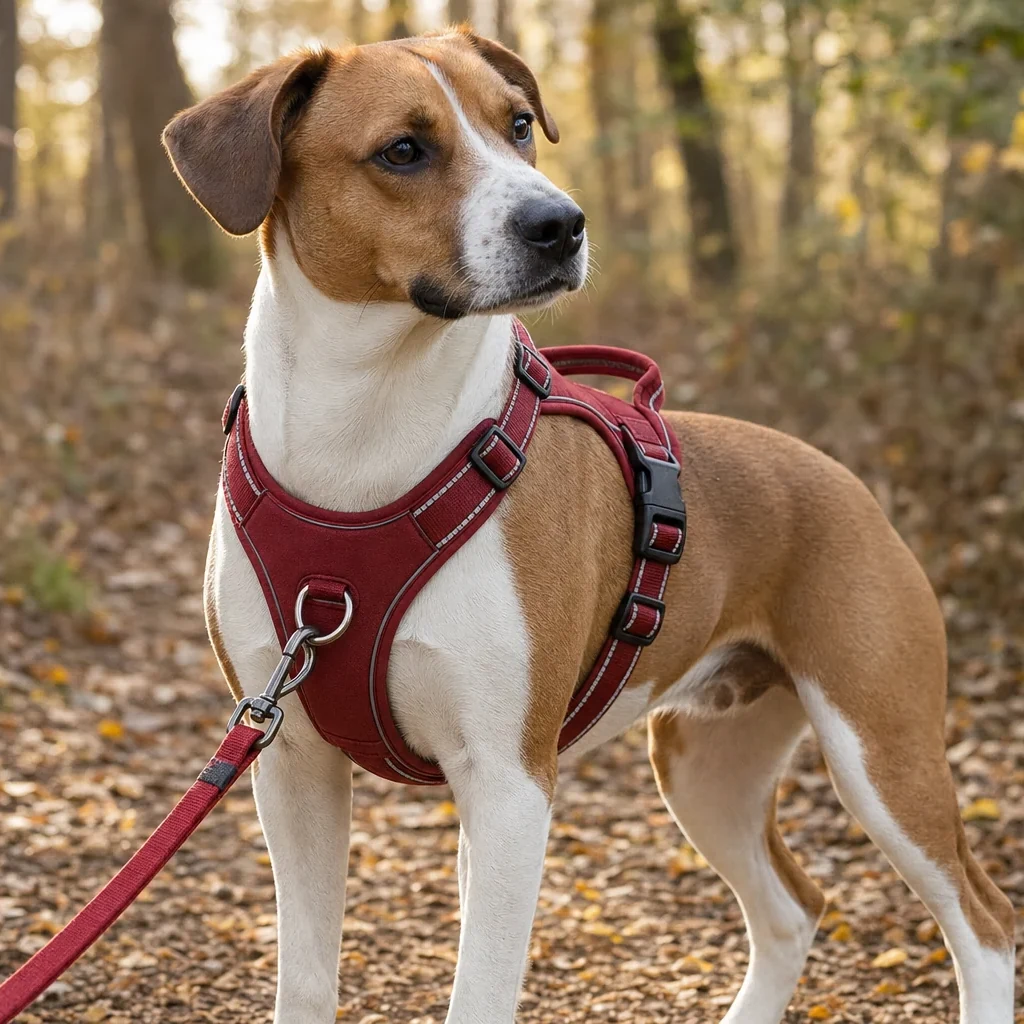
The mechanical difference in one paragraph
A dog's centre of mass sits roughly behind the shoulders. Attach a leash behind that point and any pull travels backward along the spine: the dog's footing stays square, its shoulders take the load evenly, and it can drive forward against a stable anchor. Attach the leash ahead of that point, on the breastbone, and the same pull becomes a rotation — the chest swings toward the handler and the dog ends up facing the person it was trying to leave.
Neither is a trick. It is the same physics that makes a sled harness attach at the back on purpose.
What the back clip actually did in testing
16.87 N vs 6.97 N — peak leash tension on a back-attachment harness versus a plain collar, across 52 dogs; the dogs also spent about twice as much of the walk pulling (p = 0.031). (Shih et al., Frontiers in Veterinary Science 8:735680, 2021)
Shih and colleagues compared a neck collar against a back-connection harness across 52 shelter dogs weighing 16 to 43 kg. Peak leash tension went from 6.97 newtons on the collar to 16.87 newtons on the harness. Mean tension roughly doubled. The proportion of the walk spent pulling went from 0.35 to 0.67.
Two honest caveats the authors raise themselves. The effect appeared when the dogs were working toward food and disappeared when the reward was a toy. And this was a comparison of back-clip harness against collar, not against a front clip. What it establishes is narrower than “front clips are better” — it establishes that a back-attachment harness is not a neutral piece of equipment for a dog that pulls.
What the front clip did
No significant difference — in pulling between a front-clip harness and a metal prong collar across 23 dogs; both beat a martingale collar at p = 0.001. (Johnson & Wynne, PeerJ 12:e18131, 2024)
Johnson and Wynne walked 23 dogs on four setups: a martingale collar as baseline, a front-connection harness, a polymer prong-style collar and a standard metal prong collar. All three of the non-baseline options significantly reduced pulling impulse against the martingale, each at p = 0.001.
The line that matters is the one that came after: no other differences among the equipment types were significant. The front-clip harness and the metal prong collar performed the same. One of those applies pressure with metal points around the neck; the other applies none.
Again, a limit: this trial did not test a back-clip harness or a head halter. So the two studies do not directly race a front clip against a back clip in one experiment. They approach from opposite sides and meet in the middle.
Putting the two together
| Back clip | Front clip | |
|---|---|---|
| Direction of force | Backward along the spine | Rotational, toward the handler |
| What the dog can do | Lean in and push | Gets turned instead of anchored |
| Measured against a collar | Increased tension (Shih 2021) | Reduced pulling (Johnson & Wynne 2024) |
| Leash across the front legs | Never | Only if the panel is fitted too high |
| Best for | Dogs that already walk on a loose leash | Dogs that pull |
82.7% — of owners report that their dog pulls on the lead. (Townsend et al., cited in Johnson & Wynne, 2024)
Which matters because the default case is a dog that pulls. If 82.7% of owners report pulling, then the default harness on the shelf — back-clip — is the wrong default for most of the people buying it.
When a back clip is genuinely the right answer
Three cases, and they are real rather than a courtesy.
Your dog walks on a loose leash already. A back attachment is more comfortable, the line never crosses the front legs, and there is nothing to fix. This is the case for the personalised vest.
Your dog is meant to pull. Canicross, bikejoring, scootering, or a mobility assistance dog trained to provide forward momentum. Here the back attachment is not a compromise, it is the specification.
Very small dogs. The forces involved are low enough that the mechanical argument stops carrying much weight. Comfort and fit matter more. See the small dog harness page.
The one thing a front clip asks of you
It has to be fitted low. A chest panel that rides up puts the ring under the chin, and then the leash drops across the front legs on every stride — the origin of nearly every “front clips make dogs trip” complaint. The panel belongs on the breastbone, in front of the shoulder joint. The fitting guide covers it properly.
Buyer reports — one buyer of our front-clip model wrote that the clip in front was “very practical for controlling pulling” while walking two spaniels; another reported their 25 kg pitbull “started pulling less during walks compared to when I used a leash before”. (verified buyer reviews, read September 2026)
What neither clip does
Neither trains your dog. The equipment changes where force goes; the dog learns from what gets rewarded. A front clip buys you a walk calm enough to reward a slack leash — see training a dog to stop pulling — and what makes a no-pull harness work takes the question head on.
The harness itself is on the front-clip harness page, and our sourcing method is on how we test.

Nora Whitfield · Leash-training specialist, Heelbrook
Nora has spent twelve years walking dogs that pull — first as a shelter volunteer, now fitting harnesses full time. She has fitted and stress-tested more than 400 harnesses across every body shape, and she still walks two ex-shelter pullers of her own.